Its settings and services
A module's code stays ordinary Laravel: User::query(), DB::transaction(), Cache::get(), with no connection or setting named anywhere. Whichever way its code starts (a request, a job, a command, an event, a call from another module), it runs with its own settings, its own database and its own services, and the previous module's come back afterwards.
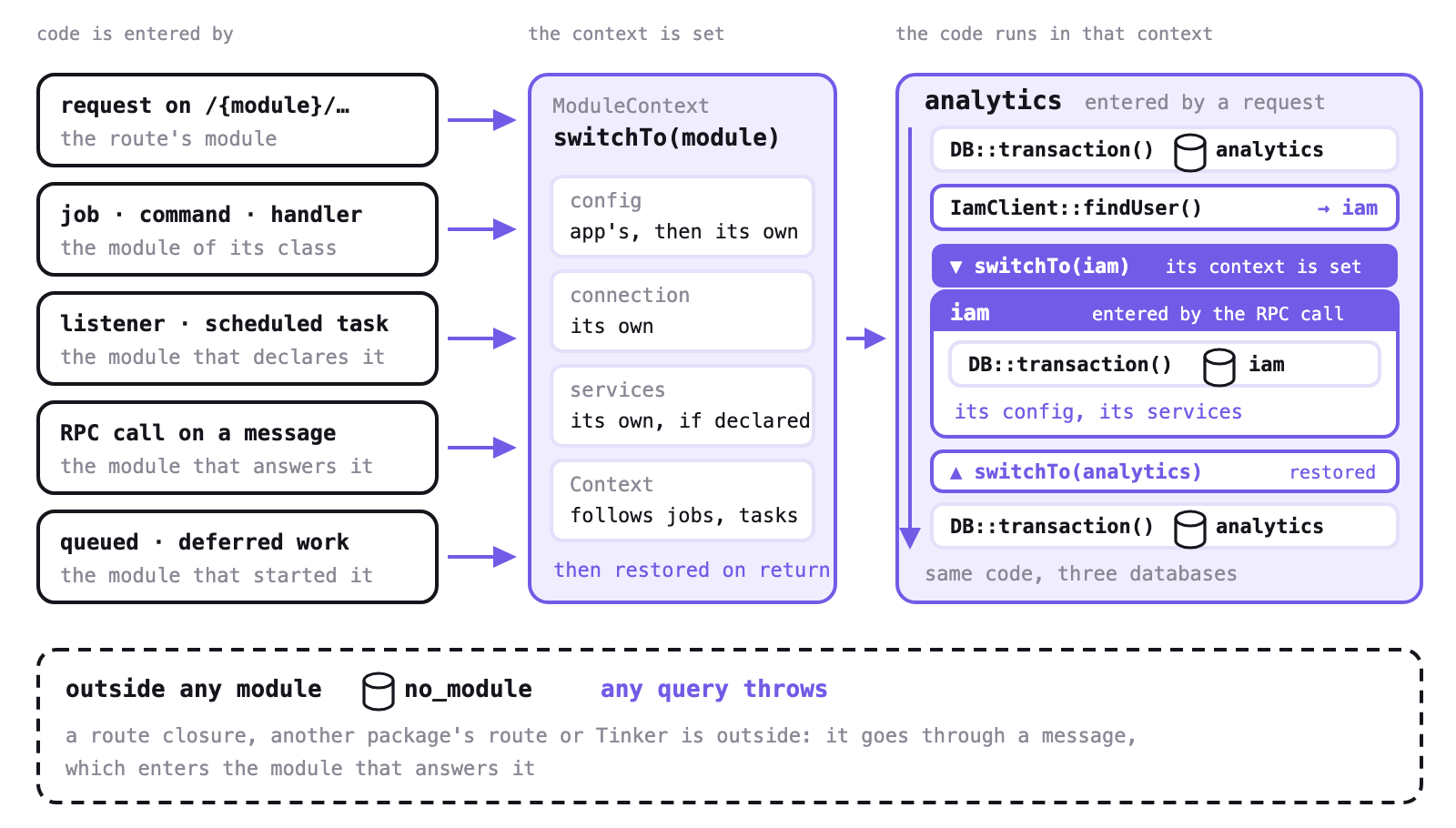
Outside any module there is no database: any query throws a ModuleException. Every database belongs to a module.
Settings, database, services
Each module runs with its own settings. A module sets them in its own config/ folder, over the application's: apps/Iam/config/database.php gives iam its connection, apps/Iam/config/cache.php its cache. While iam's code runs, config() returns iam's values.
The database
DB::table('users') and a model with no connection use the module's own connection: nothing to do.
Other services
Laravel builds the cache, the mailer, the filesystem and most package clients once, from the settings it finds the first time, then reuses them. To give each module its own, built from its own settings, list them in config/distributable.php:
'per_module' => [
    'cache', 'cache.store', 'mail.manager', 'mailer', 'filesystem', ReportBuilder::class,
],
Each one is listed under the name it is registered with, the one given to singleton():
- the cache:
cacheandcache.store; - the mailer:
mail.managerandmailer; - the disks:
filesystem; - a package's service: the name its provider gives it;
- a singleton of yours that receives one of these in its constructor, such as
ReportBuilder: its class name. Unlisted, it keeps the cache of the module it was first built in.
When it applies
You don't switch anything yourself. A module's settings apply to a request on its routes, a job, a command, an event handler, a listener it declares, a scheduled task, a call from another module, a queued closure, defer(), Concurrency::run() and Octane::concurrently(). The full list is in Its database.
When analytics calls IamClient::findUser() and iam runs in the same process, iam's handler runs with iam's settings, and analytics' come back when the method returns.
Work that runs later
For a closure of yours that runs later or elsewhere, ModuleContext::bind() keeps the current module with it:
$task = app(\Distributable\Context\ModuleContext::class)->bind(fn () => Report::rebuild());ModuleContext::current() returns the module running now, or null outside any module.
Reaching another module
A module can't run its code with another module's settings: within(), called from another module's code or from the foundation, throws a ModuleException. The way into another module is its messages, see Calling another module.